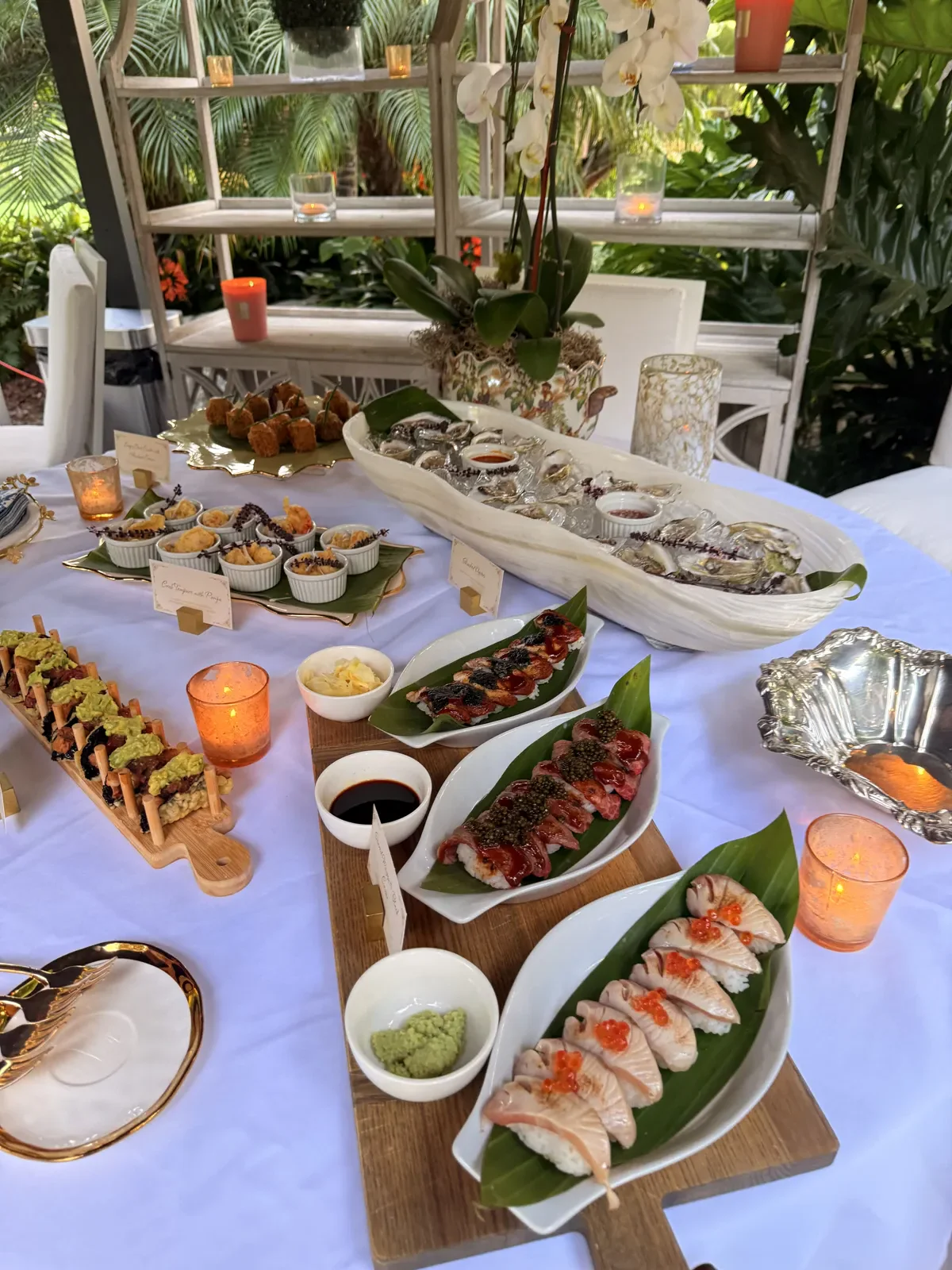
Organic & Seasonal First
People sometimes assume that a chef trained in Michelin kitchens — Maaemo in Oslo, the one-star rooms in London, Nobu in Moscow and Budapest — carries around a fixed repertoire of signature dishes, ready to deploy anywhere. The truth is almost the opposite. What those years taught me was discipline about the raw material. A great kitchen lives or dies on what comes through the back door in the morning.
So I start every event the same way: organic and seasonal, first, before anything else. Not as a marketing line, but because it’s the only honest place to begin. A tomato picked at its peak in August needs almost nothing from me — a little salt, good oil, maybe a torn leaf of basil. The same tomato shipped in February needs sugar, acid, and a dozen tricks just to taste like itself. I’d rather spend my skill amplifying something already wonderful than rescuing something that was picked too soon.
That single decision — cook what’s in season, cook what was grown without shortcuts — quietly settles a hundred smaller ones. It tells me which vegetables anchor the plate, which fruits become dessert, even which cuisine the evening leans toward. Some nights the produce wants to be French and buttery. Some nights it wants the clean lines of Japanese-French fusion. I let the ingredients cast the first vote.
The People Behind the Produce
You can’t cook this way from a warehouse. You cook it from relationships.
Most weeks you’ll find me walking the local farmers’ markets early, coffee in hand, before the crowds arrive. I’m not just filling a basket — I’m talking to the growers. Which row came in sweetest this week? What’s another few days from being ready? What did the heat do to the stone fruit? The farmers who grow on a small scale know their land the way I know my knives, and a five-minute conversation at a market table will teach me more than any supplier catalog ever could.
Over time those conversations turn into trust. The grower starts setting aside the herbs that didn’t make it onto the table, or tipping me off that the first figs are about to break. The fishmonger remembers I’d rather hear “not today” than be sold something tired. I won’t name specific farms or stands here — the good ones change with the season, and I’d rather earn each week’s harvest than pretend I have a single permanent partner. What I can promise is that the chain between the soil and your plate is short, and I’ve usually shaken the hand at the start of it.
The shortest distance between a field and a fork is a conversation. Everything good I’ve ever cooked started with one.
Choosing Fish by the Day, Not the Menu
Nowhere does this matter more than with seafood. Early in my career I learned the hard way that printing “halibut” on a menu and then chasing halibut to fill the order is how you end up serving something that traveled too far and waited too long.
So I’ve flipped it. I go to the counter and ask what came in, not what I hoped would. If the day’s catch is local and gleaming — firm flesh, clear eyes, that clean smell of cold ocean — that’s what we’re building around. A Surf & Turf menu doesn’t actually require any one fish; it requires the right fish, the one that was swimming yesterday. The cut of beef can wait for it. My techniques — the searing, the curing, the delicate Japanese hand I picked up in the Nobu kitchens — are there to honor whatever the sea offered, not to force the sea to match a plan.
It asks a little flexibility of my guests, and I’m always honest about that up front. But I’ve never had someone regret eating the better fish.
Why Southern California Makes This Possible
I could not cook this way everywhere. In a lot of places, “seasonal” means a narrow window and a long winter of compromise. Here, it means something close to the opposite.
Southern California is one of the rare corners of the world where the produce barely pauses. The light is long, the growing season stretches across most of the year, and the same drive that takes me from my kitchen to a dinner in La Jolla, Del Mar, or Rancho Santa Fe also passes more small farms and roadside stands than I could ever visit in a season. Citrus, avocados, heirloom tomatoes, delicate greens, stone fruit — something is always at its peak.
And then there’s the coastline. Cooking for clients in Coronado, Carlsbad, or Encinitas, I’m never far from where the boats come in. That nearness is a gift. It’s what lets a Coastal Luxury or Summer Californian menu feel like it genuinely belongs to this place, rather than being airlifted in. The geography does half the work; I just have to pay attention.
How Sourcing Builds Your Menu
All of this changes how I plan a private dinner — and I think it’s worth being upfront about it before you reserve a date.
When we first talk, we’ll shape the direction together: the occasion, your guests, the mood, which of my flagship menus speaks to you. But I’ll often hold the final details open until we’re close to the event, because that’s when I actually know what’s at its best. A dish I’m sure of three weeks out might get quietly improved the morning of, once I’ve seen what the market and the catch have to say.
This is the real difference between shopping a recipe and cooking what’s best today. Shopping a recipe means deciding everything in advance and then bending the ingredients to obey. Cooking what’s best means arriving open-handed and letting the finest things in the room lead. One tastes like a plan executed. The other tastes alive — brighter, more particular, unmistakably of this week. My nineteen years and every kitchen I trained in are simply there to make sure that when the best ingredient shows up, I know exactly what to do with it.